9.8-bo'lim: Polar koordinatali maydon
Ushbu bo'limda biz qutbli egri chiziqlar bilan o'ralgan maydonlarni ko'rib chiqamiz. Shuni ham yodda tutingki, biz odatda bu muammolarda bo'lgani kabi, "ostida" o'rniga "to'g'ridan-to'g'ri" dedik. Bu muammolar qutb koordinatalarida biroz boshqacha ishlaydi. Bu bo'limda biz topadigan maydon qanday ko'rinishga ega ekanligining eskizi.
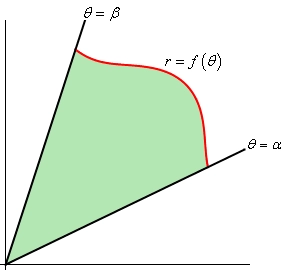
Biz yuqoridagi eskizdagi soyali joyni qidiramiz. Bu maydonni topish formulasi:
Polar egri chiziq bilan o'ralgan maydon
E'tibor bering, biz integralda \(f\left( \theta \right)\) o'rniga \(r\) dan foydalanamiz, shuning uchun integralni bajarayotganda ishonch hosil qiling va shunga mos ravishda almashtiring.
Keling, bir misolni ko'rib chiqaylik.
Yechim
Biz bu funktsiyani birinchi marta ko'rishni boshlaganimizda grafigini tuzdik qutb koordinatalari. Ushbu muammoni hal qilish uchun biz \(\theta \) qiymatlarini ham bilishimiz kerak bo'ladi, bu erda egri chiziq boshlang'ichdan o'tadi. Bularni tenglamani nolga tenglashtirib, yechish orqali olishimiz mumkin.
\[\begin{align*}0 & = 2 + 4\cos \theta \\ \cos \theta & = - \frac{1}{2}\hspace{0.5in} \Rightarrow \hspace{0.5in}\theta = \frac{{2\pi }}{3},\frac{{4\pi }}{3}\end{align*}\]Mana bu egri chiziqning ichki halqasi soyalangan eskizi.
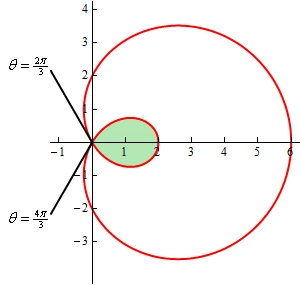
Nima uchun biz egri chiziqning kelib chiqishidan o'tadigan \(\theta \) qiymatlarini bilishimiz kerakligini tushuna olasizmi? Bu nuqtalar ichki halqaning qayerda boshlanishi va tugashini belgilaydi va shuning uchun ham formuladagi integratsiya chegaralari hisoblanadi.
Shunday qilib, maydon, keyin,
\[\begin{align*}A & = \int_{{\,\frac{{2\pi }}{3}}}^{{\,\frac{{4\pi }}{3}}}{{\frac{1}{2}{{\left( {2 + 4\cos \theta } \right)}^2}\,d\theta }}\\ & = \int_{{\,\frac{{2\pi }}{3}}}^{{\,\frac{{4\pi }}{3}}}{{\frac{1}{2}\left( {4 + 16\cos \theta + 16{{\cos }^2}\theta } \right)\,d\theta }}\\ & = \int_{{\,\frac{{2\pi }}{3}}}^{{\,\frac{{4\pi }}{3}}}{{2 + 8\cos \theta + 4\left( {1 + \cos \left( {2\theta } \right)} \right)\,d\theta }}\\ & = \int_{{\,\frac{{2\pi }}{3}}}^{{\,\frac{{4\pi }}{3}}}{{6 + 8\cos \theta + 4\cos \left( {2\theta } \right)\,d\theta }}\\ & = \left. {\left( {6\theta + 8\sin \theta + 2\sin \left( {2\theta } \right)} \right)} \right|_{\frac{{2\pi }}{3}}^{\frac{{4\pi }}{3}}\\ & = 4\pi - 6\sqrt 3 = 2.174\end{align*}\]Siz ushbu integralda bajarilgan ishlarga amal qildingiz, shunday emasmi? Ushbu bo'limda siz trig-funksiyalarning bir nechta integrallariga duch kelasiz, shuning uchun agar kerak bo'lsa, sizga qaytishingiz kerak. Trig funksiyalarni o'z ichiga olgan integrallar bo'limlari va tez ko'rib chiqish.
Shunday qilib, biz bitta egri chiziq bilan o'ralgan maydonlarni aniqlaymiz, ammo ikkita egri chiziq orasidagi maydonni topmoqchi bo'lgan quyidagi eskiz kabi vaziyatlar haqida nima deyish mumkin.
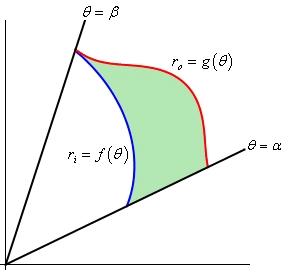
Bunday holda, ikkalasi tomonidan o'ralgan maydonni topish uchun yuqoridagi formuladan foydalanishimiz mumkin va keyin haqiqiy maydon ikkalasi orasidagi farqdir. Buning formulasi,
Ikki qutb egri chizig'i orasidagi maydon
Keling, buning bir misolini ko'rib chiqaylik.
Yechim
Mana biz kutayotgan mintaqaning eskizi.
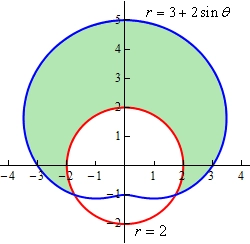
Ushbu maydonni aniqlash uchun biz ikkita egri chiziq kesishadigan \(\theta \) qiymatlarini bilishimiz kerak. Biz bu nuqtalarni ikkita tenglamani o'rnatish va yechish orqali aniqlashimiz mumkin.
\[\begin{align*}3 + 2\sin \theta & = 2\\ \sin \theta & = - \frac{1}{2}\hspace{0.5in} \Rightarrow \hspace{0.5in}\theta = \frac{{7\pi }}{6},\frac{{11\pi }}{6}\end{align*}\]Mana bu burchaklar qo'shilgan shaklning eskizi.
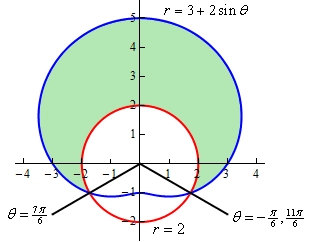
Shuni ham yodda tutingki, biz \(\frac{{11\pi }}{6}\) burchagining yana bir ko'rinishi \( - \frac{\pi }{6}\) ekanligini tan oldik. Bu muammo uchun muhim ahamiyatga ega. Yuqoridagi formuladan foydalanish uchun biz kichikroq burchakdan kattaroq burchakka o'tayotganda maydonni o'rab olishimiz kerak. Shunday qilib, agar biz \(\frac{{7\pi }}{6}\)-dan \(\frac{{11\pi }}{6}\)-ga foydalansak, biz soyali maydonni o'rab olmaymiz, aksincha, uchta mintaqaning pastki qismini qamrab olamiz. Biroq, agar biz \( - \frac{\pi }{6}\) dan \(\frac{{7\pi }}{6}\) burchaklaridan foydalansak, biz kutayotgan maydonni o'rab olamiz.
Shunday qilib, maydon, keyin,
\[\begin{align*}A & = \int_{{\, - \frac{\pi }{6}}}^{{\,\frac{{7\pi }}{6}}}{{\frac{1}{2}\left( {{{\left( {3 + 2\sin \theta } \right)}^2} - {{\left( 2 \right)}^2}} \right)\,d\theta }}\\ & = \int_{{\, - \frac{\pi }{6}}}^{{\,\frac{{7\pi }}{6}}}{{\frac{1}{2}\left( {5 + 12\sin \theta + 4{{\sin }^2}\theta } \right)\,d\theta }}\\ & = \int_{{\, - \frac{\pi }{6}}}^{{\,\frac{{7\pi }}{6}}}{{\frac{1}{2}\left( {7 + 12\sin \theta - 2\cos \left( {2\theta } \right)} \right)\,d\theta }}\\ & = \left. {\frac{1}{2}\left( {7\theta - 12\cos \theta - \sin \left( {2\theta } \right)} \right)} \right|_{ - \frac{\pi }{6}}^{\frac{{7\pi }}{6}}\\ & = \frac{{11\sqrt 3 }}{2} + \frac{{14\pi }}{3} = 24.187\end{align*}\]Keling, oldingi misolni biroz o'zgartirish bilan ishlaylik.
Yechim
Bu safar biz quyidagi mintaqani qidirmoqdamiz.
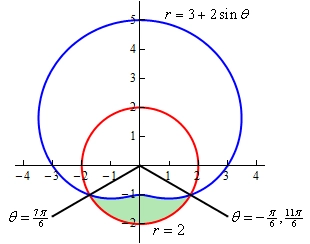
Shunday qilib, bu biz \(\frac{{7\pi }}{6}\) chegaralaridan \(\frac{{11\pi }}{6}\) gacha bo'lgan hududni olamiz. Bu hudud uchun hudud,
\[\begin{align*}A & = \int_{{\,\frac{{7\pi }}{6}}}^{{\,\frac{{11\pi }}{6}}}{{\frac{1}{2}\left( {{{\left( 2 \right)}^2} - {{\left( {3 + 2\sin \theta } \right)}^2}} \right)\,d\theta }}\\ & = \int_{{\,\frac{{7\pi }}{6}}}^{{\,\frac{{11\pi }}{6}}}{{\frac{1}{2}\left( { - 5 - 12\sin \theta - 4{{\sin }^2}\theta } \right)\,d\theta }}\\ & = \int_{{\,\frac{{7\pi }}{6}}}^{{\,\frac{{11\pi }}{6}}}{{\frac{1}{2}\left( { - 7 - 12\sin \theta + 2\cos \left( {2\theta } \right)} \right)\,d\theta }}\\ & = \left. {\frac{1}{2}\left( { - 7\theta + 12\cos \theta + \sin \left( {2\theta } \right)} \right)} \right|_{\frac{{7\pi }}{6}}^{\frac{{11\pi }}{6}}\\ & = \frac{{11\sqrt 3 }}{2} - \frac{{7\pi }}{3} = 2.196\end{align*}\]E'tibor bering, bu soha uchun "tashqi" va "ichki" funktsiyalar qarama-qarshi edi!
Keling, ushbu misolning yakuniy modifikatsiyasini qilaylik.
Yechim
Mana bu misol uchun eskiz.
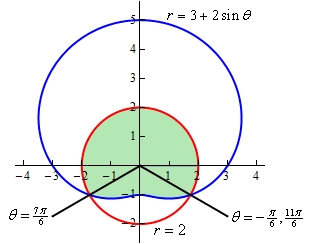
Biz bu muammoni oldingi ikkitasini qilgandek hal qila olmaymiz. Biridan ikkinchisiga ko'payganimizda, bu hududni o'rab olishga imkon beradigan cheklovlar to'plami yo'q. Esda tutingki, biz \(\theta \) ni oshirganimizda, biz kutayotgan maydon o'ralgan bo'lishi kerak. Biroq, biz ishlashimiz mumkin bo'lgan \(\theta \) uchun ikkita diapazon bu mintaqani emas, balki oldingi ikkita misoldagi hududni qamrab oladi.
Biroq, bu holda, bu katta muammo emas. Ushbu muammoda hududni olishning ikki yo'li mavjud. Biz ikkalasini ham ko'rib chiqamiz.
Yechim 1
Bunday holda, aylana ikki qismga bo'linganiga e'tibor bering va biz yuqori qismdan keyin turibmiz. Shuningdek, biz 3-misolda pastki qismning maydonini topganimizga e'tibor bering. Shuning uchun, maydon,
Yechim 2
Bu holda biz deyarli bir xil ishni qilamiz, bundan tashqari bu safar biz 2-misolda ko'rib chiqilayotgan qismdan ko'ra limakonning boshqa qismi deb hisoblaymiz. Shuningdek, bu holatda limakonning maydonini hisoblashimiz kerak bo'ladi.
Shunday qilib, ushbu yondashuvdan foydalanadigan maydon
\[\begin{align*}{\mbox{Area}} & = {\mbox{Area of Limacon}} - {\mbox{Area from Example 2}}\\ & = \int_{{\,0}}^{{\,2\pi }}{{\frac{1}{2}{{\left( {3 + 2\sin \theta } \right)}^2}\,d\theta }} - 24.187\\ & = \int_{{\,0}}^{{\,2\pi }}{{\frac{1}{2}\left( {9 + 12\sin \theta + 4{{\sin }^2}\theta } \right)\,d\theta }} - 24.187\\ & = \int_{{\,0}}^{{\,2\pi }}{{\frac{1}{2}\left( {11 + 12\sin \theta - 2\cos \left( {2\theta } \right)} \right)\,d\theta }} - 24.187\\ & = \left. {\frac{1}{2}\left( {11\theta - 12\cos \left( \theta \right) - \sin \left( {2\theta } \right)} \right)} \right|_0^{2\pi } - 24.187\\ & = 11\pi - 24.187\\ & = 10.370\end{align*}\]Biroz uzoqroq yondashuv, lekin ba'zida biz bu uzoqroq yondashuvni qo'llashga majbur bo'lamiz.
Ushbu so'nggi misol ko'rsatganidek, biz qutb koordinatalaridagi barcha maydonlarni integraldan to'g'ridan-to'g'ri ololmaydi.