8.4-bo'lim: Gidrostatik bosim va kuch
Ushbu bo'limda biz vertikal plastinkani suvga botiramiz va biz suv bosimi tufayli plastinkaga ta'sir qiladigan kuchni bilmoqchimiz. Bu kuch ko'pincha gidrostatik kuch deb ataladi.
Bu erda biz ikkita asosiy formuladan foydalanamiz. Birinchidan, agar biz sirtdan \(d\) metr pastda bo'lsak, gidrostatik bosim quyidagicha ifodalanadi:
\[P = \rho gd\]Bu erda \(\rho \) - suyuqlikning zichligi va \(g\) - tortishish tezlanishi. Biz ko'rib chiqilayotgan suyuqlikni suv deb hisoblaymiz va biz metrik tizimdan foydalanmoqchi bo'lganimiz uchun bu miqdorlar,
\[\rho = 1000{\mbox{ kg/}}{{\mbox{m}}^{\mbox{3}}}\hspace{0.25in}\hspace{0.25in}g = 9.81{\mbox{ m/}}{{\mbox{s}}^{\mbox{2}}}\]Bizga kerak bo'lgan ikkinchi formula quyidagicha. Faraz qilaylik, \(P\) doimiy bosimi \(A\) maydoni bo'lgan sirtga ta'sir qiladi. Keyin hududga ta'sir qiluvchi gidrostatik kuch,
\[F = PA\]E'tibor bering, biz ushbu formuladan foydalangan holda vertikal plastinkadagi gidrostatik kuchni topa olmaymiz, chunki bosim chuqurlikka qarab o'zgaradi va shuning uchun bu formula talab qiladigan darajada doimiy bo'lmaydi. Biroq, bu bizning ishimiz uchun kerak bo'ladi.
Ushbu muammolar qanday ishlashini ko'rishning eng yaxshi usuli - bir yoki ikkita misol.
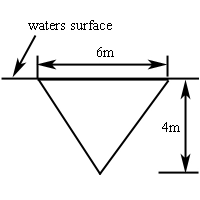
Yechim
Bu erda qilinadigan birinchi narsa eksa tizimini o'rnatishdir. Shunday qilib, keling, yuqoridagi eskizni quyidagi o'q tizimi qo'shilgan holda takrorlaymiz.
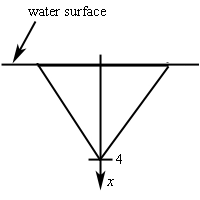
Shunday qilib, biz \(x\) o'qini shunday yo'naltiramizki, ijobiy \(x\) pastga, \(x = 0\) suv yuzasiga va \(x = 4\) uchburchak uchining chuqurligiga mos keladi.
Keyin uchburchakni \(n\) gorizontal chiziqlariga bo'lamiz, har biri teng kenglikdagi \(\Delta x\) va har bir \(\left[ {{x_{i - 1}},{x_i}} \right]\) oralig'ida istalgan \(x_i^*\) nuqtasini tanlang. Hisob-kitoblarni osonlashtirish uchun biz ushbu chiziqlar haqida ikkita taxmin qilamiz. Birinchidan, biz uchlari qiya bo'lishini e'tiborsiz qoldiramiz va chiziqlar to'rtburchaklar deb hisoblaymiz. Agar \(\Delta x\) etarlicha kichik bo'lsa, bu bizning hisob-kitoblarimizga unchalik ta'sir qilmaydi. Ikkinchidan, \(\Delta x\) har bir chiziqdagi gidrostatik bosim deyarli doimiy bo'ladigan darajada kichik deb taxmin qilamiz.
Quyida vakillik chizig'i mavjud.
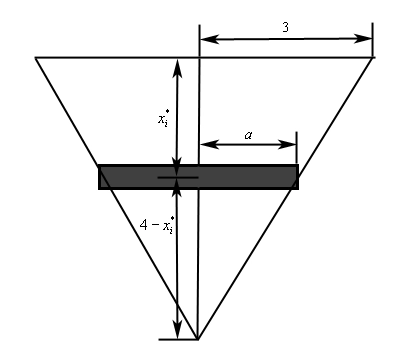
Ushbu chiziqning balandligi \(\Delta x\), kengligi esa 2\(a\). \(a\) ni quyidagi tarzda aniqlash uchun shunga o'xshash uchburchaklardan foydalanishimiz mumkin,
\[\frac{3}{4} = \frac{a}{{4 - x_i^*}}\hspace{0.25in}\hspace{0.25in} \Rightarrow \hspace{0.25in}\hspace{0.25in}a = 3 - \frac{3}{4}x_i^*\]Endi, biz ushbu chiziqdagi bosim doimiy deb hisoblaganimiz sababli, bosim quyidagicha ifodalanadi:
\[{P_i} = \rho gd = 1000\left( {9.81} \right)x_i^* = 9810x_i^*\]va har bir chiziqdagi gidrostatik kuch,
\[{F_i} = {P_i}\,A = {P_i}\left( {2a\Delta x} \right) = 9810x_i^*\left( 2 \right)\left( {3 - \frac{3}{4}x_i^*} \right)\Delta x = 19620x_i^*\left( {3 - \frac{3}{4}x_i^*} \right)\,\Delta x\]Plastinkadagi taxminiy gidrostatik kuch barcha chiziqlardagi kuchlarning yig'indisi yoki,
\[F \approx \sum\limits_{i = 1}^n {19620x_i^*\left( {3 - \frac{3}{4}x_i^*} \right)} \,\Delta x\]Cheklovni qabul qilish aniq gidrostatik kuchni oladi,
\[F = \mathop {\lim }\limits_{n \to \infty } \sum\limits_{i = 1}^n {19620x_i^*\left( {3 - \frac{3}{4}x_i^*} \right)} \,\Delta x\]dan foydalanish aniq integralning ta'rifi bu boshqa narsa emas,
\[F = \int_{{\,0}}^{{\,4}}{{19620\left( {3x - \frac{3}{4}{x^2}} \right)\,dx}}\]Gidrostatik kuch u holda,
\[\begin{align*}F &= \int_{{\,0}}^{{\,4}}{{19620\left( {3x - \frac{3}{4}{x^2}} \right)\,dx}}\\ & = \left. {19620\left( {\frac{3}{2}{x^2} - \frac{1}{4}{x^3}} \right)} \right|_0^4\\ & = 156960\,N\end{align*}\]Keling, yana bir misolni ko'rib chiqaylik.
Yechim
Birinchidan, dumaloq plastinkaning yuqori qismi suv ostida 6 metr bo'lgan deb taxmin qilamiz. Keyinchalik, eksa tizimining kelib chiqishi plitaning markazida bo'lishi uchun eksa tizimini o'rnatamiz. O'q tizimini shu tarzda o'rnatish bizning ishimizni ancha soddalashtiradi.
Nihoyat, biz plastinkani yana \(n\) gorizontal chiziqlariga bo'lamiz va har bir chiziqdan \(y_i^*\) nuqtasini tanlaymiz. Hisoblashda yordam berish uchun chiziqlar yana to'rtburchaklar shaklida bo'ladi deb taxmin qilamiz. Bu erda sozlashning eskizi.
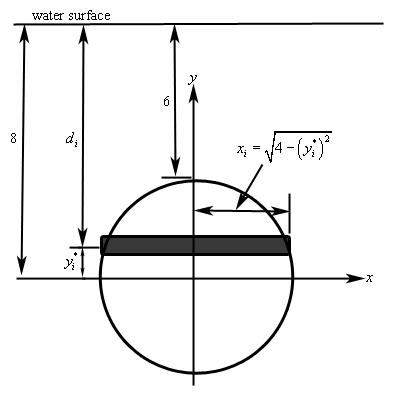
Har bir chiziqning suv sathi ostidagi chuqurligi,
\[{d_i} = 8 - y_i^*\]va bu o'z navbatida bizga chiziqqa bosim beradi,
\[{P_i} = \rho g{d_i} = 9810\left( {8 - y_i^*} \right)\]Har bir chiziqning maydoni,
\[{A_i} = 2\sqrt {4 - {{\left( {y_i^*} \right)}^2}} \,\,\Delta y\]Har bir chiziqdagi gidrostatik kuch,
\[{F_i} = {P_i}{A_i} = 9810\left( {8 - y_i^*} \right)\left( 2 \right)\sqrt {4 - {{\left( {y_i^*} \right)}^2}} \,\,\Delta y\]Plastinkadagi umumiy kuch,
\[\begin{align*}F & = \mathop {\lim }\limits_{n \to \infty } \sum\limits_{i = 1}^n {19620\left( {8 - y_i^*} \right)\sqrt {4 - {{\left( {y_i^*} \right)}^2}} \,\,\Delta y} \\ & = 19620\int_{{\, - 2}}^{{\,2}}{{\left( {8 - y} \right)\sqrt {4 - {y^2}} \,dy}}\end{align*}\]Ushbu integralni bajarish uchun biz uni ikkita integralga bo'lishimiz kerak.
\[F = 19620\int_{{\, - 2}}^{{\,2}}{{8\sqrt {4 - {y^2}} \,dy}} - 19620\int_{{\, - 2}}^{{\,2}}{{y\sqrt {4 - {y^2}} \,dy}}\]Birinchi integral \(y = 2\sin \theta \) trigni almashtirishni, ikkinchi integral esa \(v = 4 - {y^2}\) almashtirishni talab qiladi. Ushbu almashtirishlardan foydalangandan so'ng biz quyidagilarni olamiz:
\[\begin{align*}F & = 627840\int_{{\, - {\pi }/{2}\;}}^{{\,{\pi }/{2}\;}}{{{{\cos }^2}\theta \,d\theta }} + 9810\int_{{\,0}}^{{\,0}}{{\sqrt v \,dv}}\\ & = 313920\int_{{\, - {\pi }/{2}\;}}^{{\,{\pi }/{2}\;}}{{1 + \cos \left( {2\theta } \right)\,d\theta }} + 0\\ & = 313920\left. {\left( {\theta + \frac{1}{2}\sin \left( {2\theta } \right)} \right)} \right|_{ - \frac{\pi }{2}}^{\frac{\pi }{2}}\\ & = 313920\pi \end{align*}\]E'tibor bering, almashtirishdan keyin biz ikkinchi integral nolga teng bo'lishini bilamiz, chunki yuqori va pastki chegara bir xil.