6.4-bo'lim: Silindrli hajm
Oldingida biz inqilobning qattiq jismlarining hajmlarini topishni boshladik. Ushbu bo'limda biz halqalar yoki disklar bo'lgan kesmalarni oldik, kesma maydonini topdik va keyin qattiq jismning hajmini topish uchun quyidagi formulalardan foydalandik.
\[V = \int_{{\,a}}^{{\,b}}{{A\left( x \right)\,dx}}\hspace{0.75in}V = \int_{{\,c}}^{{\,d}}{{A\left( y \right)\,dy}}\]Oldingida biz faqat disk yoki halqa shaklida bo'lgan kesmalardan foydalanganmiz. Biroq, bu har doim ham shunday bo'lishi shart emas. Biz ko'rib chiqayotgan qattiq jismni to'liq qoplash uchun kengaytirilishi yoki qisqarishi mumkin bo'lsa, biz har qanday shaklni tasavvurlar uchun ishlatishimiz mumkin. Bu yaxshi narsa, chunki bizning birinchi misolimiz shuni ko'rsatadiki, biz doimo halqalarni/disklarni ishlata olmaymiz.
Yechim
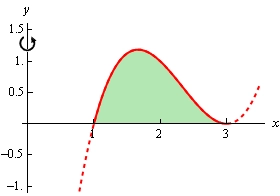
Oldingida qilganimizdek, avval chegaralangan mintaqa va qattiq grafigini tuzamiz. E'tibor bering, bu erda chegaralangan hudud ko'rsatilgan soyali qismdir. Egri chiziq qanday ko'rinishini ko'rsatish uchun undan biroz o'tib cho'zilgan.
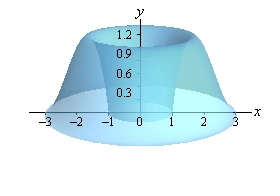
Shunday qilib, bizda asosan donut shaklidagi narsa bor. Agar biz ushbu qattiq ustidagi halqalarni ishlatadigan bo'lsak, bu erda odatiy halqa qanday ko'rinishga ega bo'lar edi.
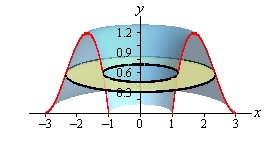
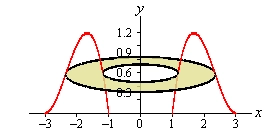
Bu bir qancha muammolarga olib keladi. Birinchidan, ichki va tashqi radius bir xil funktsiya bilan aniqlanadi. Buni, o'z-o'zidan, biz bir misolda ko'rganimizdek, vaqti-vaqti bilan hal qilish mumkin Egri chiziqlar orasidagi maydon bo'limi. Biroq, bu odatda boshqa usullarga qaraganda ko'proq ishni anglatadi, shuning uchun ko'pincha bu eng yaxshi yondashuv emas.
Bu bizni bu erda olgan ikkinchi muammoga olib keladi. Halqalardan foydalanish uchun biz ushbu funktsiyani \(x = f\left( y \right)\) shakliga qo'yishimiz kerak. Bu odatda kub polinom uchun oson EMAS va boshqa hollarda buni amalga oshirish ham mumkin emas. Hatto buni qilish mumkin bo'lsa ham, natijada olingan tenglama ko'pincha asl nusxadan sezilarli darajada chalkash bo'lib, bu ham muammolarni keltirib chiqarishi mumkin.
Bu holda halqalar bilan bog'liq oxirgi muammo unchalik muammo emas, chunki u faqat qo'shilgan ishdir. Agar biz halqalarni ishlatadigan bo'lsak, chegara \(y\) chegaralari bo'lar edi va bu biz grafikning qanchalik baland ekanligini bilishimiz kerakligini anglatadi. Shu paytgacha integratsiya chegaralari har doim topish oson bo'lgan kesishish nuqtalari bo'lgan. Biroq, bu holda eng yuqori nuqta kesishish nuqtasi emas, balki nisbiy maksimaldir. Biz hosilalarni qo'llash bobida funksiyalarning maksimal qiymatlarini qanday topish haqida gapiradigan bir nechta bo'limlarni o'tkazdik. Biroq, ularni topish, ba'zida biroz mehnat talab qilishi mumkin.
Shunday qilib, biz bu holatda halqalar bilan bog'liq uchta muammoni ko'rdik, bu bizning ish yukimizni oshiradi yoki uzuklardan foydalanishimizga to'g'ri kelmaydi.
Biz qilishimiz kerak bo'lgan narsa, biz ishlashimiz mumkin bo'lgan tasavvurlar maydonini beradigan qattiqni kesishning boshqa usulini topishdir. Buni qilishning bir yo'li - bizning qattiqimizni pechene xamirining bir bo'lagi deb hisoblash va uni aylanish o'qiga perpendikulyar kesish o'rniga, biz silindrsimon pechene to'sarni aylanish o'qiga qo'yib, uni qattiq massaga surishimiz mumkin. Buni amalga oshirish quyidagi rasmni beradi,
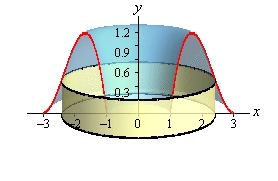
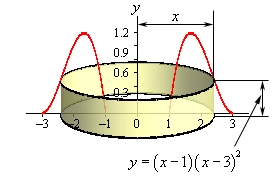
Bu bizga ob'ektda silindr yoki qobiqni beradi va biz uning sirt maydonini osongina topishimiz mumkin. Ushbu silindrning sirt maydoni,
\[\begin{align*}A\left( x \right) & = 2\pi \left( {{\mbox{radius}}} \right)\left( {{\mbox{height}}} \right)\\ & = 2\pi \left( x \right)\left( {\left( {x - 1} \right){{\left( {x - 3} \right)}^2}} \right)\\ & = 2\pi \left( {{x^4} - 7{x^3} + 15{x^2} - 9x} \right)\end{align*}\]Shuni ham yodda tutingki, silindrning radiusini oshirsak, biz qattiq jismni to'liq qoplaymiz va shuning uchun biz ushbu qattiq jismning hajmini topish uchun formulamizdan foydalanishimiz mumkin. Bizga kerak bo'lgan yagona narsa - integratsiya chegaralari. Birinchi silindr \(x = 1\) da qattiq jismga kesiladi va biz \(x\) ni \(x = 3\) ga oshirsak, biz qattiq jismning ikkala tomonini to'liq qoplaymiz, chunki silindrni bir yo'nalishda kengaytirish uni avtomatik ravishda boshqa yo'nalishda ham kengaytiradi.
U holda bu qattiq jismning hajmi,
\[\begin{align*}V & = \int_{{\,a}}^{{\,b}}{{A\left( x \right)\,dx}}\\ & = 2\pi \int_{{\,1}}^{{\,3}}{{{x^4} - 7{x^3} + 15{x^2} - 9x\,dx}}\\ & = 2\pi \left. {\left( {\frac{1}{5}{x^5} - \frac{7}{4}{x^4} + 5{x^3} - \frac{9}{2}{x^2}} \right)} \right|_{\,1}^{\,3}\\ & = \frac{{24\pi }}{5}\end{align*}\]Oxirgi misolda ishlatiladigan usul deyiladi silindrlar usuli or qobiqlar usuli. Barcha holatlarda maydon formulasi quyidagicha bo'ladi:
Tsilindrning maydoni
Ushbu usul va halqalar/disklar usuli o'rtasida bir nechta muhim farqlar mavjud, ularni davom ettirishdan oldin e'tiborga olishimiz kerak. Birinchidan, vertikal o'q atrofida aylanish \(x\) funktsiyasi bo'lgan maydonni beradi va gorizontal o'q atrofida aylanish \(y.\) funktsiyasi bo'lgan maydonni beradi Bu halqalar/disklar usuliga mutlaqo ziddir.
Ikkinchidan, biz avvalgi bo'limda bo'lgani kabi integratsiya chegaralari uchun \(x\) yoki \(y\) ning to'liq assortimentini olmaymiz. Buning o'rniga biz qattiq jismning bir tomonini qoplaydigan \(x\) yoki \(y\) diapazonini olamiz. Birinchi misolda ta'kidlaganimizdek, agar biz bir tomonni qoplash uchun radiusni kengaytirsak, biz avtomatik ravishda boshqa tomonni yopish uchun boshqa yo'nalishda ham kengayamiz.
Keling, yana bir misolni ko'rib chiqaylik.
Yechim
Avval chegaralangan mintaqa va qattiq jismning grafigini olamiz.
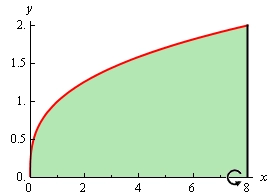
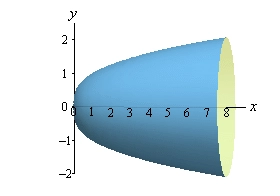
OK, biz gorizontal o'q atrofida aylanamiz. Bu shuni anglatadiki, maydon \(y\) funktsiyasi bo'ladi va shuning uchun bizning tenglamamiz ham \(x = f\left( y \right)\) shaklida yozilishi kerak bo'ladi.
\[y = \sqrt[3]{x}\hspace{0.25in}\hspace{0.25in} \Rightarrow \hspace{0.25in}\,\,\,x = {y^3}\]Ring/disk bo'limida qilganimizdek, odatdagi silindrni bir necha bor ko'rib chiqaylik. Chapdagi eskiz o'ng eskizga qandaydir kontekstni berish uchun eskizda ham ob'ektning orqa yarmi bilan odatiy silindrni ko'rsatadi. O'ngdagi eskiz odatdagi silindrni va faqat qattiq jismning chetini belgilaydigan egri chiziqlarni o'z ichiga oladi.
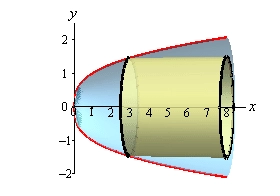
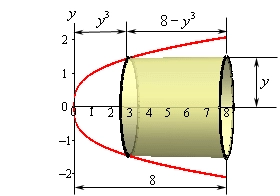
Bu holda silindrning kengligi oldingi misolda bo'lgani kabi funktsiya qiymati emas. Bu holda funktsiya qiymati silindrning chekkasi va \(y\) o'qi orasidagi masofadir. Chetdan chiziqgacha bo'lgan masofa \(x = 8\) va shuning uchun kenglik \(8 - {y^3}\) bo'ladi. Bu holda kesma maydoni,
\[\begin{align*}A\left( y \right) & = 2\pi \left( {{\mbox{radius}}} \right)\left( {{\mbox{width}}} \right)\\ & = 2\pi \left( y \right)\left( {8 - {y^3}} \right)\\ & = 2\pi \left( {8y - {y^4}} \right)\end{align*}\]Birinchi silindr \(y = 0\) da qattiq jismga aylanadi va oxirgi silindr \(y = 2\) da kesiladi va shuning uchun bu bizning integratsiya chegaralarimizdir.
Bu qattiq jismning hajmi,
\[\begin{align*}V & = \int_{{\,c}}^{{\,d}}{{A\left( y \right)\,dy}}\\ & = 2\pi \int_{{\,0}}^{{\,2}}{{8y - {y^4}\,dy}}\\ & = 2\pi \left. {\left( {4{y^2} - \frac{1}{5}{y^5}} \right)} \right|_{\,0}^{\,2}\\ & = \frac{{96\pi }}{5}\end{align*}\]Ushbu bo'limdagi qolgan misollar \(x\) va \(y\) o'qlaridan tashqari o'q atrofida aylanish o'qiga ega bo'ladi. Halqalar/disklar usulida bo'lgani kabi, biz ham ular bilan biroz ehtiyot bo'lishimiz kerak.
Yechim
Mana, chegaralangan va qattiq jismning grafigi.
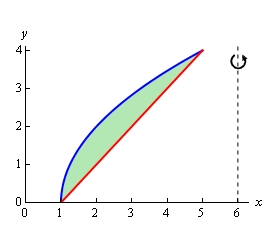
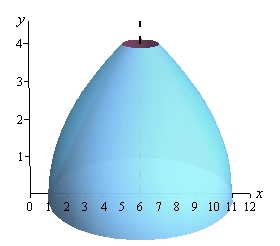
Bu erda odatiy silindrning eskizlari mavjud. Shunga qaramay, chapdagi eskiz o'ngdagi eskiz uchun ba'zi kontekstni taqdim etish uchun bu erda.
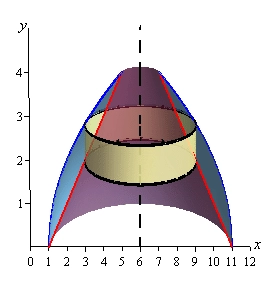
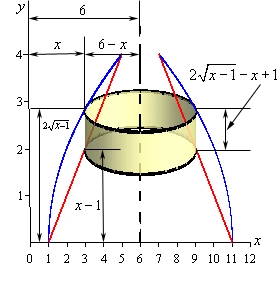
Mayli, chapdagi eskizda ko'p narsa bor. Avval e'tibor bering, radius avvalgi ikki holatda bo'lgani kabi faqat \(x\) yoki \(y\) emas. Bu holda \(x\) -dan masofa y‑ o'qi silindrning chetiga va bizga aylanish o'qidan silindrning chetiga qadar bo'lgan masofa kerak. Bu shuni anglatadiki, bu silindrning radiusi \(6 - x\).
Ikkinchidan, silindrning balandligi bu holda ikkita funktsiyaning farqidir.
Keyin kesma maydoni,
\[\begin{align*}A\left( x \right) & = 2\pi \left( {{\mbox{radius}}} \right)\left( {{\mbox{height}}} \right)\\ & = 2\pi \left( {6 - x} \right)\left( {2\sqrt {x - 1} - x + 1} \right)\\ & = 2\pi \left( {{x^2} - 7x + 6 + 12\sqrt {x - 1} - 2x\sqrt {x - 1} } \right)\end{align*}\]Endi birinchi tsilindr \(x = 1\) da qattiq jismga, oxirgi silindr esa \(x = 5\) da qattiqga kesiladi, shuning uchun bizning chegaralarimiz bor.
Mana ovoz balandligi.
\[\begin{align*}V & = \int_{{\,a}}^{{\,b}}{{A\left( x \right)\,dx}}\\ & = 2\pi \int_{{\,1}}^{{\,5}}{{{x^2} - 7x + 6 + 12\sqrt {x - 1} - 2x\sqrt {x - 1} \,dx}}\\ & = 2\pi \left. {\left( {\frac{1}{3}{x^3} - \frac{7}{2}{x^2} + 6x + 8{{\left( {x - 1} \right)}^{\frac{3}{2}}} - \frac{4}{3}{{\left( {x - 1} \right)}^{\frac{3}{2}}} - \frac{4}{5}{{\left( {x - 1} \right)}^{\frac{5}{2}}}} \right)} \right|_{\,1}^{\,5}\\ & = 2\pi \left( {\frac{{136}}{{15}}} \right)\\ & = \frac{{272\pi }}{{15}}\end{align*}\]Oxirgi atamaning integratsiyasi biroz qiyin, shuning uchun buni shu erda qilaylik. Bu almashtirishdan foydalanadi,
\[u = x - 1\hspace{0.25in}du = dx\hspace{0.25in}x = u + 1\] \[\begin{align*}\int{{2x\sqrt {x - 1} \,dx}} & = 2\int{{\left( {u + 1} \right){u^{\frac{1}{2}}}\,du}}\\ & = 2\int{{{u^{\frac{3}{2}}} + {u^{\frac{1}{2}}}\,du}}\\ & = 2\left( {\frac{2}{5}{u^{\frac{5}{2}}} + \frac{2}{3}{u^{\frac{3}{2}}}} \right) + c\\ & = \frac{4}{5}{\left( {x - 1} \right)^{\frac{5}{2}}} + \frac{4}{3}{\left( {x - 1} \right)^{\frac{3}{2}}} + c\end{align*}\]Biz o'yinda shunday almashtirishlardan birini ko'rdik almashtirish bo'limi.
Yechim
Biz birinchi navbatda u erda kesishish nuqtalarini olishimiz kerak.
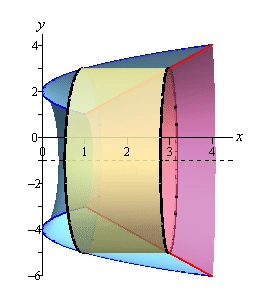
\[\begin{align*}y & = {\left( {y - 2} \right)^2}\\ y & = {y^2} - 4y + 4\\ 0 & = {y^2} - 5y + 4\\ 0 & = \left( {y - 4} \right)\left( {y - 1} \right)\end{align*}\]Shunday qilib, ikkita egri chiziq \(y = 1\) va \(y = 4\) nuqtalarida kesishadi. Bu erda chegaralangan hudud va qattiq jismning eskizi.
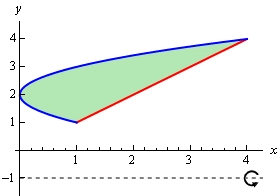
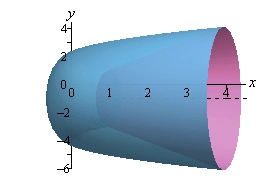
Bu erda odatiy silindrning eskizlari mavjud. Chapdagi eskiz o'ngdagi eskiz uchun bir oz kontekstni taqdim etish uchun bu erda.
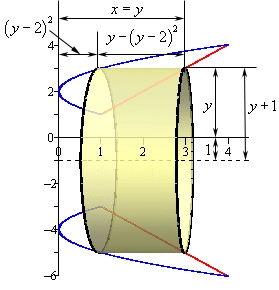
Mana bu silindr uchun kesma maydoni.
\[\begin{align*}A\left( y \right) & = 2\pi \left( {{\mbox{radius}}} \right)\left( {{\mbox{width}}} \right)\\ & = 2\pi \left( {y + 1} \right)\left( {y - {{\left( {y - 2} \right)}^2}} \right)\\ & = 2\pi \left( { - {y^3} + 4{y^2} + y - 4} \right)\end{align*}\]Birinchi tsilindr \(y = 1\) da qattiq jismga, oxirgi silindr esa \(y = 4\) da kesiladi. Keyin hajm,
\[\begin{align*}V & = \int_{{\,c}}^{{\,d}}{{A\left( y \right)\,dy}}\\ & = 2\pi \int_{{\,1}}^{{\,4}}{{ - {y^3} + 4{y^2} + y - 4\,dy}}\\ & = 2\pi \left. {\left( { - \frac{1}{4}{y^4} + \frac{4}{3}{y^3} + \frac{1}{2}{y^2} - 4y} \right)} \right|_{\,1}^{\,4}\\ & = \frac{{63\pi }}{2}\end{align*}\]